At the end of our last article, I had just finished rebuilding the mowing deck with new bearings. This was my attempt to lower the amperage draw of the mowing deck. Lower amperage means smaller batteries or longer run times which was my main concern.
Thankfully, Ben Nelson came to my aid again. A few days ago, he lent me a couple of his batteries. These are group 31 100Ah gel cell batteries. They aren’t in great condition, but would be very similar to the batteries I had been thinking about using. These are big batteries and weigh in at about 70 lbs each.
The first test I did was only with two batteries. This 24V test let me know that 24V just isn’t enough power to cut with my mower. The motor slowed way down and the blades just wouldn’t spin fast enough. I did this just to get a feel for how other voltages worked out on the mower. The driving speed at 24V was just right, so I should be able to size my drive pulley for any other voltage.
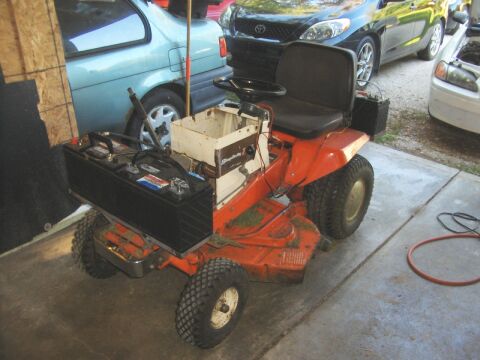
The second test I did with three batteries or 36V. I know it looks funny, but its what I had on hand at the time and it is just for testing. This test went off great. The pulleys are still over sized, so amperage draw is probably a bit higher than it normally would be. Anyway, with this setup I was driving around at around 10-20A. Engaging the mowing deck this time around only increase amperage pull by another 25A! The rebuild was a complete success and dropped the mowing deck amperage draw by 66%! Continuing on with testing, when cutting grass and moving at a normal cutting speed, it was pulling around 50-75A.
This is the realistic load I was after. This is the number that I will size the battery pack for.
At the end of the last update, I had just finished testing out the mower for the first time. I found that just driving the mower around doesn’t take much power, but the mowing deck was taking a ton of power. So, I asked for help on the forum here and at the local EV (electric vehicle) club that I’m a member of. The guys suggested that I take a look at the mowing deck and make sure that it was in good condition and there wasn’t any binding or bad bearings stealing my power.
As it turns out, the deck wasn’t in horrible shape, but some attention and a rebuild definitely couldn’t hurt. It was completely packed full of grass around the pulleys. So, the first step was cleaning it up. The picture above is after I removed the initial huge clumps of dead grass, and given it a fair cleaning. It was pretty caked full of stuff.
I also looked at the bearings. It looked like they hadn’t been greased in quite some time. I spun a few of the mower blades and two of the three didn’t make the greatest noise. This meant it was time for new bearings. By and far, this is t he most expensive part of the mower yet. I went ahead and got high quality Timken bearings from the local bearing supply place. However, I was assured by the salesman that these bearings will probably outlast me, and they also don’t require greasing like the old style. This was worth it to me.
So, the next step was to start rebuilding the deck. It was disassembled, and the bearings were replaced. I also took the time to sharpen the blades while they were off the mower. Then, it was put back together. A pretty simple process that was only a bit of a pain.
With the mower deck rebuilt, I can do testing to see what good the rebuild did.
Thats right, the EcoRider is alive! I got the motor mounted, threw a few batteries on it and was able to do some testing.
Thankfully, a friend of mine (Ben Nelson – website) who is also into electric vehicles gave me the gauge you see above, and another friend got me the shunt for the gauge. So, I was able to measure how many amps the mower pulls while using it for doing different things. This will help me size my battery pack and make a decision on what voltage I want it to run at. To measure voltage I just used a cheapo digital multimeter I had laying around.
This is the test setup. I had two batteries laying around. One was a deep cycle, and one was a starting battery. I had to pull another starting battery out of my car to get three on the mower for the test.
With everything strapped or bolted down it was time for a test drive. The mower ran around great at 36 volts. It pulled 20-25A while tooling around the yard. However, I quickly found out that my pulleys are a bit large. First gear is faster than I’d like it to be for precision maneuvering, second gear is faster than I would normally mow, and third is warp speed for a lawn mower. However, I am happy that the amperage draw is still relatively low for just tooling around.
This brings us to the mowing part. Once I engaged the mowing deck, my amperage immediately jumped 75A higher. This kicked the total amperage draw up to right around 100A constant. This is definitely higher than I had hoped. One consolation I have is that I know my pulley is too large. Going with a smaller pulley will kick the speed back down and will decrease amperage draw some what.
The test run gave me some very good information. With it I can now make some informed decisions about batteries, their capacity and what voltage I want to run. But, it also leaves me with some questions like how can I lower the amperage draw to extend battery life?
It has been a while since the last update has come. So, I am splitting the update into multiple parts. If you are impatient and need to see the latest updates, feel free to check out the EcoRider forum thread. It has all the latest day to day updates in it. For the rest of you, continue reading.
Last I reported, I had gathered a bunch of parts for the mower from a friend who owns a recycling business. He donated a motor, contactors, heavy gauge wire, a controller, and even a bunch of small batteries. This really got the project jump started.
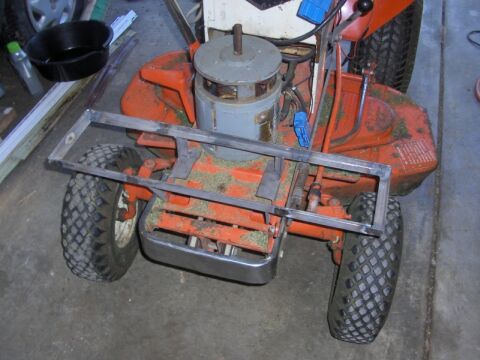
I started with the motor and figured out how I wanted it mounted to the mower. It was fairly simple. The motor will replace the gas engine with the shaft facing downward. This allows me to use the existing pulley system and makes for a pretty simple conversion. However, the motor does not have any provisions for mounting its face to the mower chassis. So, this required taking the motor apart and tapping holes in one end of it.
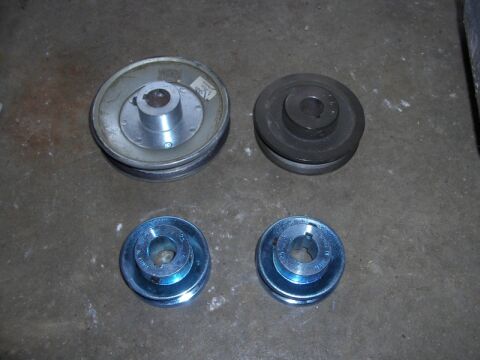
The next problem with this is that the pulleys from the gas engine had a 1″ inner diameter, and my motor has a 3/4″ shaft. So, it was time to get a new pulley set. I purchased pulleys of the same size since I am not sure what the actual rpm of the motor will be. I might have get new ones if the speeds are off.
The next thing on the list was to start making battery trays/holders. This quickly turned out to be a huge pain in the butt. Eventually, I decided that mounting 24 batteries is more hassle than it is worth. I returned the 24 small batteries to their previous owner and decided that going with larger batteries would be the way I want to go.
Last week, I took a trip to a local recycling facility. The owner, a friend of mine, gratiously donated a slew of parts to the project. I really like this idea. I realize not everyone might be able to get donated parts, but a recycling center just takes these things apart for scrap. If you can get the parts for the price of scrap, they’ll gladly get rid of it simply because its no work for them (rather than having to disassemble it).
The motor is a Baldor 24V 1.6HP. Rule of thumb is that when replacing a gas engine you divide its peak horsepower by 4 to get the electric motor horsepower you need. So, its a little on the small side. The gas engine was 8 horsepower. But, I think that it will work just fine since you very rarely use all 8 horsepower the gas engine provides. It has a foot mount on it, and no holes for face mounting, so I’ll need to drill and tap some holes in it to mount the face against the mower frame.
I also got a box of contactors. These are very similar to a simple relay, except they are really heavy duty and can handle a lot of amperage flowing through them. I’ll likely use one for the main on/off switch. Along with the contactors came some pretty beefy 0 gauge wire too.
To top it all off, I even got a bunch of batteries. These batteries are very small (about half the size of a motorcycle battery) 12V 7Ah, and will have to be put in parallel to keep the voltage down, but they’ll hopefully be easier to find space for since they are small.
These parts, all together, are the bulk of what I need for the mower. The rest should just be odds and ends like fasteners, and other miscellaneous things. I will need to get new pullies for the mower too since the shaft sizes are different between the motor and gas engine. However, thats just a trip to the local farm supply shop. Finding the correct ratios to go with may be a bit more difficult I’m afraid.